How to Choose the Best Local Commercial Contractors for Your Project
- NRG Consulting & Contracting

- May 18
- 5 min read
Why Choosing the Right Local Commercial Contractors Defines Your Project's Success

Local commercial contractors offer distinct advantages for facility owners and operations leaders managing complex industrial or commercial builds in British Columbia.
How to find and evaluate local commercial contractors — quick answer:
Search local builder directories and associations for vetted firms in your region (Surrey, Langley, Abbotsford, etc.)
Check project portfolios for experience in your facility type (GMP, industrial, healthcare, commercial TI)
Verify licensing, insurance, and BC Building Code compliance
Visit completed project sites and speak directly with past clients
Confirm local subcontractor networks and regional supply chain relationships
Assess communication structure — look for a single point of accountability and a clear project delivery model
Narrowing the field to the right local partner for a regulated industrial or commercial project takes a disciplined approach.
The stakes are real. A contractor unfamiliar with Fraser Valley site conditions, municipal permitting processes, or BC's seismic and building code requirements can introduce operational disruption before a single wall goes up.
I'm Craig Garden, founder of NRG Consulting & Contracting, and I built NRG specifically to serve the mid-scale commercial and industrial market — the segment that demands the most technical precision and most often gets underserved by generalist local commercial contractors. Below, I'll walk you through exactly what to look for when selecting a construction partner for your next project.
Strategic Benefits of Partnering with Local Commercial Contractors
When we evaluate the decision between a national firm and a regional expert, the benefits of local expertise extend far beyond the build. While choosing a regional business strengthens the local community, the operational benefits provide even more significant advantages for industrial facility owners.
National firms often lack the granular understanding of the BC Building Code and specific municipal nuances in the Fraser Valley. We value our community reputation as our most important asset; we live and work in the same areas where we build, which drives a higher standard of craftsmanship and integrity.
Face-to-face communication remains the most effective tool for risk management. In-person meetings on-site allow us to identify potential conflicts in MEP (Mechanical, Electrical, and Plumbing) coordination or structural constraints before they impact the project. This level of accessibility ensures that when challenges arise, you have a partner who can be on-site to implement a solution.
Local vs. National Firm Capability Comparison
Feature | Local Commercial Contractors | National Firms |
Regulatory Knowledge | Deep understanding of BC Building Code & municipal bylaws | General knowledge; often rely on third-party consultants |
On-site Presence | Local | Remote |
Subcontractor Relations | Established, long-term regional partnerships | Often hire unknown local subcontractors based on availability |
Site Condition Awareness | Expertise in Fraser Valley soil, seismic, and weather | Limited regional geological or climate context |
Accountability | Community-based reputation stakes | Contractual only; remote management |
Partnering with a firm that understands the Essential guide to general contracting services ensures your project benefits from a streamlined delivery model tailored to the British Columbia landscape.
Regional Regulatory Expertise and Site Knowledge
Navigating the permitting process in Surrey, Langley, or Abbotsford requires more than just filling out forms; it requires a working relationship with municipal planning departments. Local commercial contractors understand the specific seismic requirements and soil conditions unique to the Fraser Valley. For example, a project in Chilliwack may face different environmental or flood plain considerations than one in Maple Ridge or Mission.
We anticipate these regional variables during the pre-construction phase. This proactive approach prevents the complications that occur when a non-local contractor encounters an unexpected municipal bylaw or a specific BC Building Code interpretation. We build our General contracting expertise on this foundation of regional intelligence, ensuring your facility meets all safety and compliance standards without unnecessary rework.
Enhanced Accessibility with Local Commercial Contractors
The design-build model thrives on accessibility. When the design team and the construction team operate under one roof locally, project transparency increases. We utilize an integrated project delivery approach where stakeholder collaboration happens in real-time.
For industrial facility owners, this means you never wonder about the status of your plant expansion or tenant improvement. Frequent site visits allow us to maintain occupied-site controls, ensuring that construction activities do not jeopardize your ongoing operations. Choosing Local commercial contractors ensures that the people making the decisions are the same people walking the site every day.
Leveraging Established Fraser Valley Subcontractor Networks
Construction is a team sport. The quality of your build depends on the skilled trades performing the work. Because we have spent years building relationships with specialized subcontractors across the Lower Mainland, we have access to reliable labor even during busy periods.
These established networks lead to better supply chain coordination. We know which suppliers can deliver specialized materials—such as washdown-safe surfaces or medical-grade HVAC components—on time. This reliability supports hygienic design and process flow in manufacturing environments. For a deeper look at how these relationships benefit your project, see our What is general contracting complete guide.
Critical Steps to Evaluate Your Construction Partner
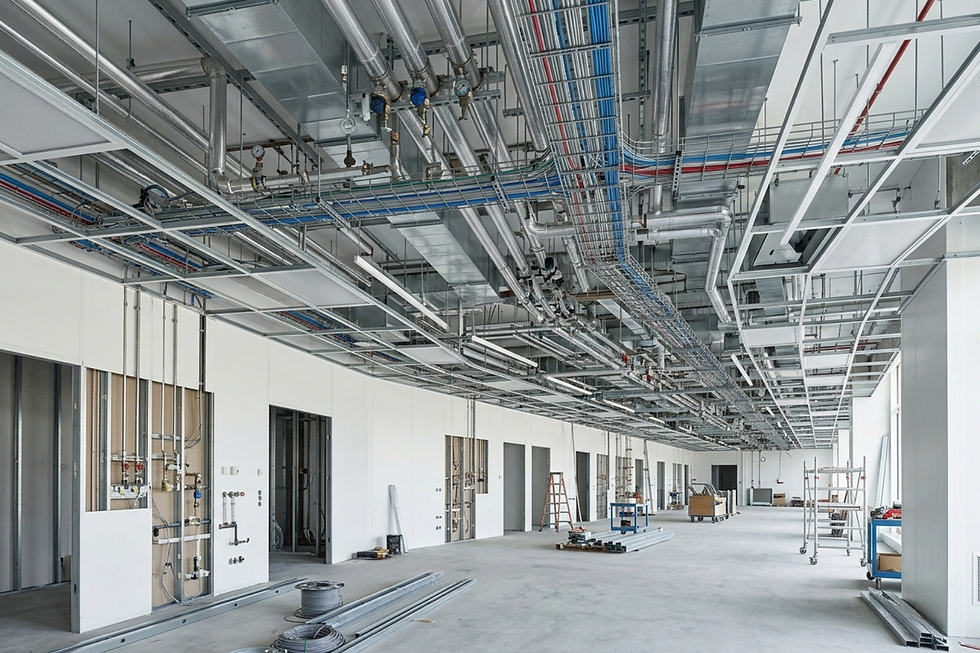
Evaluating a contractor for a regulated environment—such as a food processing plant or a pharmaceutical lab—requires a different set of criteria than a standard commercial build. You must look beyond the surface-level portfolio and examine their technical proficiency and safety protocols.
A Licensed general contractor must demonstrate a deep understanding of the operational risks inherent in your industry. When vetting potential partners, ask for specific examples of how they have managed MEP coordination in high-density ceiling spaces or how they have handled firestopping in sensitive cleanroom environments.
Technical Proficiency in Regulated Environments
If your project involves GMP (Good Manufacturing Practice) facilities or cleanrooms, the contractor must understand cleanliness classifications and sanitation workflows. In British Columbia, pharmaceutical and nutraceutical operators must adhere to Canadian GMP standards.
We focus on the tangible construction aspects that support these standards:
Hygienic Design: Utilizing materials that withstand rigorous chemical cleaning.
HVAC Systems: Coordinating complex air filtration and pressure differential requirements.
Process Flow: Ensuring the physical layout supports the movement of materials and personnel without cross-contamination.
Mechanical Coordination: Managing the integration of process piping, specialized power, and data pathways.
Our approach to commercial services prioritizes these technical details to ensure your facility passes its final commissioning and validation phases without issue.
Vetting Local Commercial Contractors via Project History
A contractor's past projects indicate future success. When reviewing portfolios, look for projects that mirror the complexity of your own. If you are developing a lab-adjacent office or a healthcare administrative space, you need a partner who understands life safety systems, accessibility requirements under the BC Building Code, and the nuances of TAB (Testing, Adjusting, and Balancing) for HVAC systems.
Request references from facility managers or operations directors. Ask them about the contractor's ability to maintain a clean site and their effectiveness in communicating project updates. A reputable firm will encourage you to visit their completed sites. Seeing the quality of the finishing work—and how well a facility has held up after several years of operation—provides peace of mind that your facility will meet long-term operational requirements. We prioritize this level of scrutiny, as outlined in our Essential guide to general contracting services.
Conclusion: Securing Operational Excellence in British Columbia
Selecting the right local commercial contractors is a strategic decision that impacts the operational integrity of your facility. In the Fraser Valley, where industrial and regulated spaces demand high-end precision, you need a partner who combines regional knowledge with technical expertise.
At NRG Consulting & Contracting, we provide a one-stop design-build solution that eliminates the friction between design and execution. Whether you are planning a plant expansion in Abbotsford, a tenant improvement in Langley, or a new industrial build in Surrey, our focus remains on project delivery and operational excellence. We don't just build structures; we build the environments that allow your business to thrive.
Ready to discuss your next project? Explore our commercial services and see how our integrated approach can support your facility's goals.


Comments